mjml: Render MJML responsive email templates to HTML
A Haskell implementation of the MJML email framework. It renders MJML documents to the same HTML that the reference JavaScript implementation produces, without Node.js at runtime.
[Skip to Readme]

Modules
[Index] [Quick Jump]
Downloads
- mjml-0.1.0.1.tar.gz [browse] (Cabal source package)
- Package description (as included in the package)
Maintainer's Corner
For package maintainers and hackage trustees
Candidates
- No Candidates
| Versions [RSS] | 0.1.0.0, 0.1.0.1 |
|---|---|
| Change log | CHANGELOG.md |
| Dependencies | base (>=4.20 && <5), containers (>=0.6 && <0.9), text (>=2.0 && <2.2), text-builder-linear (>=0.1.3 && <0.2), transformers (>=0.6 && <0.7) [details] |
| Tested with | ghc ==9.10.3 || ==9.12.4 || ==9.14.1 |
| License | MIT |
| Copyright | 2026 Kronor |
| Author | José Lorenzo Rodríguez |
| Maintainer | lorenzo@kronor.io |
| Uploaded | by lorenzo at 2026-10-31T09:16:22Z |
| Category | Text, Web, Email |
| Distributions | |
| Reverse Dependencies | 1 direct, 0 indirect [details] |
| Downloads | 6 total (6 in the last 30 days) |
| Rating | (no votes yet) [estimated by Bayesian average] |
| Your Rating | |
| Status | Docs uploaded by user Build status unknown [no reports yet] |
Readme for mjml-0.1.0.1
[back to package description]mjml
Render MJML responsive email templates to HTML from Haskell, without Node.js.
MJML describes an email with a few components (sections, columns, text,
images, buttons) and compiles them to the nested tables, inline styles and
Outlook conditional comments that render the same in every mail client, with
columns that stack on phones. This package is a port of the reference
JavaScript implementation and produces the same HTML as MJML 5. To write
templates in Haskell with compile-time checks, see
mjml-hamlet.
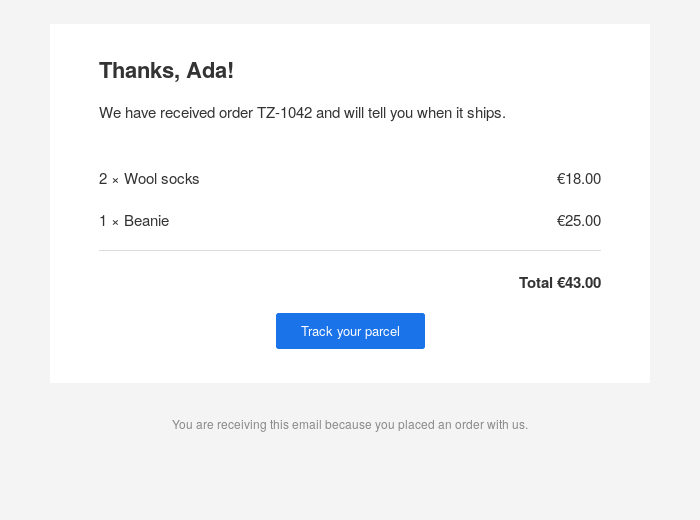
An order confirmation rendered by this package, on a desktop client and on a
phone (the template is in the mjml-hamlet README):

import Data.Text.IO qualified as T
import Text.Mjml (defaultOptions, renderText)

main :: IO ()
main =
    either print T.putStrLn $
        renderText defaultOptions
            "<mjml>\
            \  <mj-body>\
            \    <mj-section>\
            \      <mj-column>\
            \        <mj-text font-size=\"20px\">Your order is on its way</mj-text>\
            \        <mj-button href=\"https://example.com/track\">Track it</mj-button>\
            \      </mj-column>\
            \    </mj-section>\
            \  </mj-body>\
            \</mjml>"
Escaping
Like MJML, the renderer copies attribute values and the content of ending tags
(mj-text, mj-button, mj-raw, …) into the output as they are: they are
HTML source, not text. Escape anything that comes from user data before putting
it into a document.
Compatibility
The output is compared with MJML 5.4.1 for the 155 documents in
test/fixtures. The comparison ignores whitespace, attribute order and the
order of CSS declarations, and nothing else.
Not supported yet:
mj-include, which MJML also ignores unless asked to read files;- inlining
<mj-style inline="inline">(the style is kept in the head); mj-html-attributes;- minification and beautification.
Updating the fixtures
The expected HTML is regenerated with the reference implementation:
npm ci --prefix scripts
node scripts/update-fixtures.mjs
License
MIT. The fixture inputs come from mrml,
also MIT; see test/fixtures/NOTICE.md.